
National Tree Day
There were Canoe trees, trees with Mistletoe that provide food for Honeyeaters (e.g. Painted Honeyeaters) and many other birds, rough bark trees that provide great habitat for lizards, trees that provide wonderful nesting sites, trees with unusual pods that provide food for the Glossy Black Cockatoos, dead trees that provide hollows as nesting sites for Superb and Turquoise parrots, bee trees for native bees that help in the pollination of agricultural and native plants, trees planted to honour our Veterans and trees we played in as kids. Sadly I found photos I found photos of beautiful trees that have been removed along roadsides and in the middle of paddocks. Given it takes 15-20 years to grow a substantial shelterbelt it seems unreasonable that trees should be removed with little thought as to who might be using them as: a home, food source, nesting site, shade, windbreaks or as protection to cool farms dams. Given it takes 100 years to produce a hollow in a tree, to see some of these old growth trees removed from our landscape is heart breaking. Some community members and landholders spend months growing seedlings to plant in wetlands and on farms while other members of the community spend time removing old trees for seemingly little or no reason. |
Recording a Rakali Sighting at Narrandera Wetlands
A lot of the usual waterbirds (Egrets, Spoonbills and Herons) were noticeably absent but the woodland birds were abundant. The results can be seen here http://birdata.birdlife.org.au/survey?id=3159913&h=3dde711d Whilst walking around the Wetlands looking for birds both Alan and Nella observed an Australian Water Rat swimming around and Nella said it rated as a “significant sighting”. I didn’t see it and couldn’t get a photo. Later that day I pondered the best way to somehow report this sighting – iNaturalist didn’t seem the best platform due to the way it’s structured (you basically need a photo). “Bio-collect” didn’t seem right either, so I looked up the Australian Platypus Conservancy website https://platypus.asn.au/, who are also interested in Water Rats. Their sighting form was easy to fill in and submit, and I got a very appreciative email thanking me for the observation. It included an attachment with information on Hydromys chrysogaster or Rakalis. |
Our Walk up Mt Caley 13 June
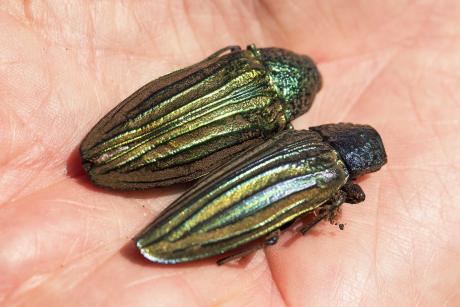
On our walk in this relatively wet year we saw mounds of iridescently green mosses and Pomaderris cocoparrana seedlings emerging amongst the rocks with occasional last year’s plants which were larger and had escaped chewing by goats with a few daring to flower. The common Dwarf Greenhood (Pterostylis nana) was flowering everywhere. The hoods of the individuals in a clump face all different directions, this may be to increase their chances of pollinations by tiny fungi gnats. Remains of Autumn greenhood (Pterostylis revoluta ) were seen and the robust rosettes of Midget Greenhood (Pterostylis mutica) yet to flower in Spring. Steve turned over a rock to look at termites only to uncover a large green legged centipede (genus Cormocephalus)! It must have been having a feast. Other invertebrates seen were a lovely Australian Golden Orbweaver (Trichonephila edulis) and an iridescent beetle (Pseudotaenia waterhousi). (Thanks to identification from iNaturalist). |
Revisit to MIA I Sandhill Rehabilitation Site
I drive past this site quite regularly and could see changes but took advantage of a day off to explore a bit further. The sandhill has a green covering at the moment, so different from June 2018! Weeds are abundant but some native ground layer veg. is evident. The direct seeded species have grown considerably since 2018. This during two harsh summers and dry winters. It seems if the right plant can get established in the first couple of seasons, they can carry on almost regardless. The photos show the difference between 2018 and 2020. |
Unseasonal flowering
Even the Travelling Stock Reserves near Narrandera are great floristically. And if you know what you are looking at you come to realise that most of the plants are native. The Autumn rain and the warm conditions have caused some triggering of unseasonal flowering after our long dry spell. The Sticky Everlasting a yellow paper daisy can be found on the roadsides. Lower to the ground you can see another yellow flower that resembles scrambled eggs. These are Goodenia genus and there are about three different species about, a tiny one, one that scrambles and one on a long thin stem. Two purple flowering daisies can be found. One has hand shaped leaves and will leave you with little burrs in your socks. This one is commonly called Burr Daisy!! The other shorter purple daisy has fine leaves and can be white or pink and much sweeter. |
DOUBLE BUT DIFFERENT
As I alighted from the car at Jacks Creek Picnic area, I was fanned by the feather-soft, pale green fronds of a Weeping Wilga - the ‘weeping’ being my personal descriptor of this beautiful native bush - bountifully budding for a late Winter blossoming. As the bright, windless Autumn day warmed up we set off on our looped walk. On ascending the track we were presented with a western vista of glorious green, where a month or so prior there had been only brown. The recent rains had also brought forth an array of wildflowers – ever the opportunists. Among these were the profuse white Native Tobacco, and the less abundant but even lovelier Blue Pincushions – and golden Cluster Everlasting Daisies. |
The makings of a MFN group in Wagga Wagga
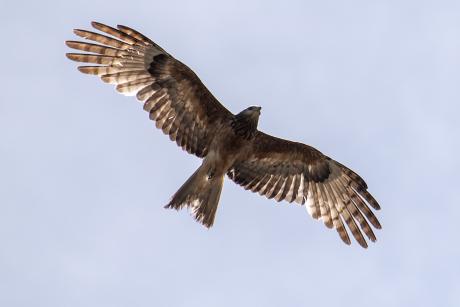
Melanie with some other wildlife enthusiasts organised a breakfast at the Murrumbidgee Wetlands for World Wetlands Day on 2 February. They spent a couple of hours there and saw about 37 bird species. A highlight was the Black-shouldered Kite which they watched diving for a mouse which it ate perched on a tree branch. The event featured coverage by The Daily Advertiser. |
Seasonal dispersal of birds from our area
At certain times some species are relatively easy to locate yet at other times they can't be found locally. A perfect example of this is the Superb Parrot. They arrive in Leeton in early Spring and are seen in town and around the district, especially along the river, in large numbers. To me it is a joy to see their return and to know that they, until recent years, were on the “Vulnerable' list with numbers in decline in the late nineties. Fortunately after a number of good breeding years their numbers have increased and they are now considered less so. At this time of year mid to late February they leave the area and are more difficult to locate – especially in the winter months. After a successful breeding season they will seek a food source where ever they can, often appearing in areas where they are not usually seen – like Nericon for example where Neil Palframan reported them for the first time this season. They are still about but from now on they are difficult to locate although in the past year or so small numbers are able to be found all year if you look hard enough in the right places – like at Yanco Reserve or the Leeton Golf Course. |
Murrumbidgee Valley National Park (Cuba Forest)
We turned off the road and as soon as we were over the grid and into the National Park proper we pulled up to walk along the billabong that was in the process of being filled up with what I presume is Environmental Water. The big birding highlights from this 1st stop were the 100 plus ducks that flew off when we first arrived, the lack of water birds present (may be because they hadn’t yet found it as it was still filling up), and the nesting pair of Brown Treecreepers. The other notable from this stop was the series of blue ear tags nailed to some of the trees. These where associated with silver insulation tied around the tree. An email to Charles Sturt University, Institute for Land, Water and Society after I got home confirmed the suspicion that the ear tags were markers for a research project. To quote from the email that I received back from Dr Damian Michael Senior Research Fellow, “The ear tag should have been accompanied by a silver cover which I am temporarily using as an artificial bark cover to examine arboreal lizard populations across the Murrumbidgee catchment. The tag is identifying the tree.” I am going to follow up further to see if there is more information available in relation to how long and if there are any preliminary findings yet. |
Murrumbidgee Field Naturalists Trip to McCann Road & Griffith Area: Saturday 27 July 2019
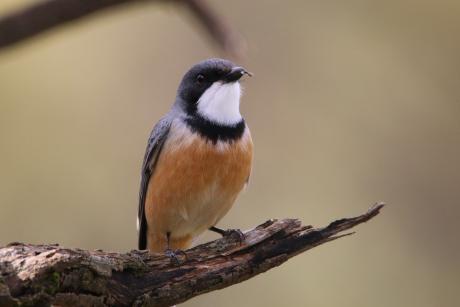
Fortunately their trust was rewarded, as we waited the obligatory 10 minutes after the scheduled time and then made our way to McCann Road. This is a small patch of vegetation near Lake Wyangan which I had only visited briefly a couple of times before during Twitchathons. It is a great spot with a good range of birds including the regular Honeyeaters, Thornbills and Wrens while a few specials were the Golden Whistler, Rufous Whistler and White-fronted Honeyeater. After a good look around we headed for Lake Wyangan picnic area for a combined Morning Tea and Lunch. Then off to Campbell Swamp, which didn't produce a lot of birds but the views of the Swamp Harrier, Hobby and Kestrel were very nice. A quick stop over at the Griffith airport where we were able to find the Pink Cockies we were seeking plus some others including Rainbow Lorikeets and Mallee Ringnecks. |
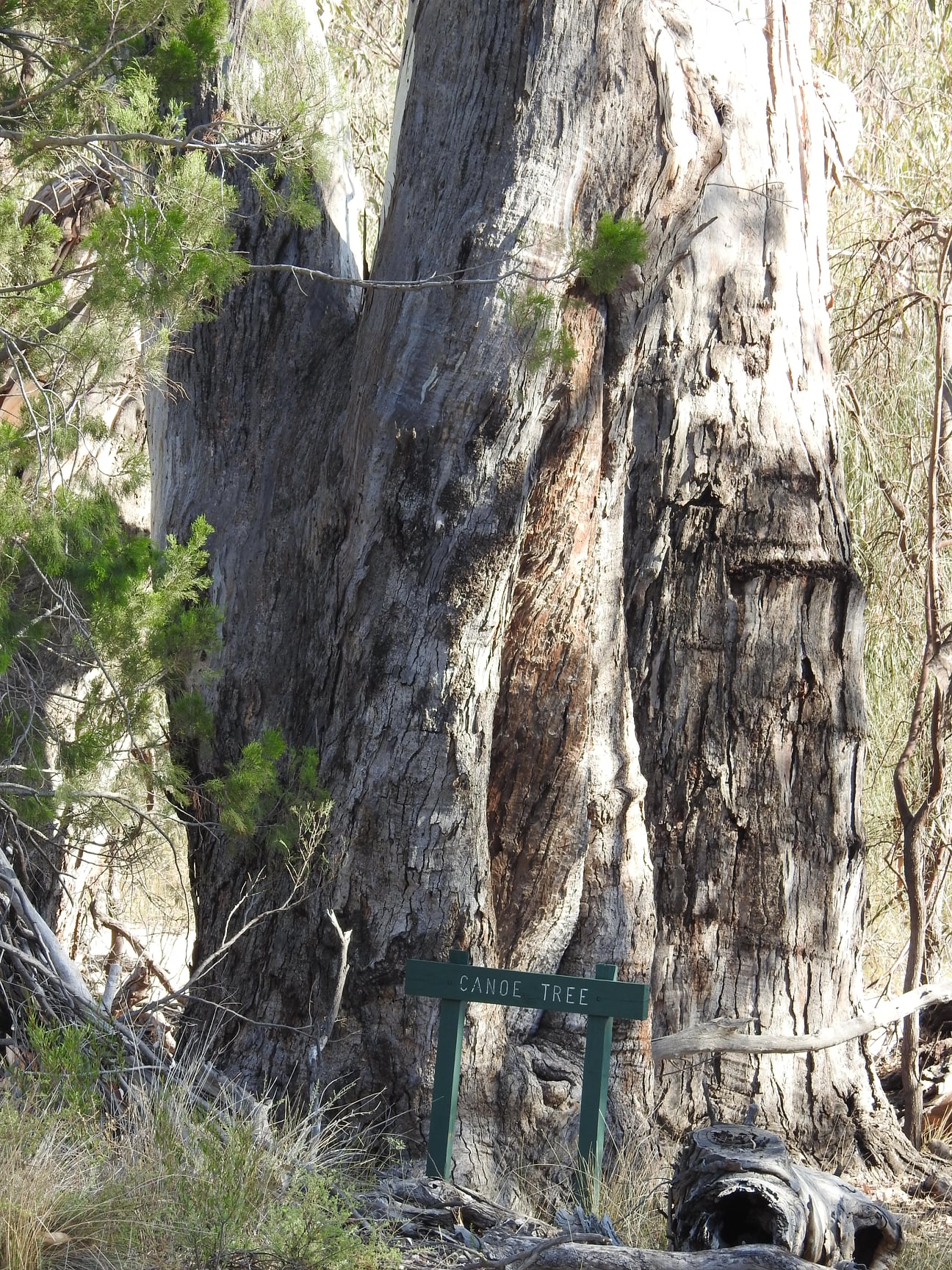 When I looked through all the photos I have collected over the last few years I came across so many photos of beautiful trees that had so many different purposes in our local landscape.
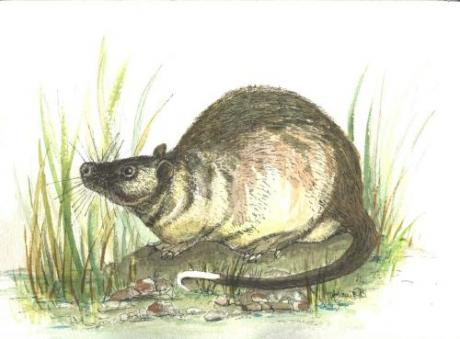 Narrandera Landcare started doing quarterly bird surveys at the Narrandera Wetlands 18 months ago and we are very appreciative of the help Alan and Nella give us to compile the surveys. We use the handy Birdata app and usually record around 30 species. Our last survey was 2 July 2020 and we observed 31 species.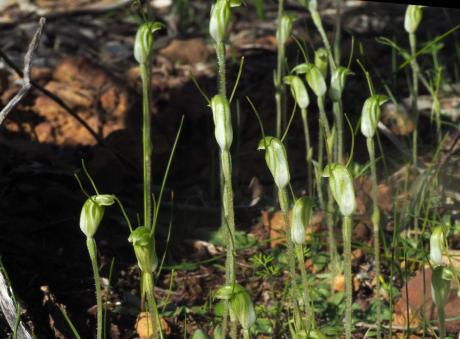
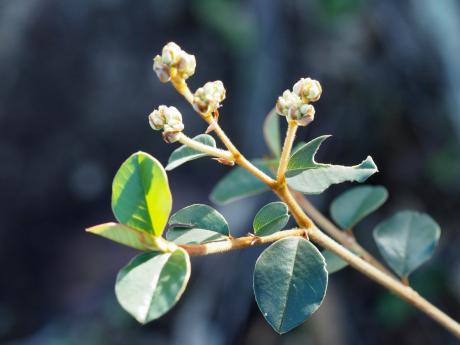 When John Oxley passed this way in June 1817 he wrote in his diary “We saw no game with the exception of three or four kangaroo rats, many beautiful small parrots were observed, and as barren as the scrub appeared to us, yet our botanists reaped an excellent harvest here. We passed over a rugged, barren, and rocky country for about four miles and a half when we ascended a hill upon our right which promised a view in all directions. To the southward, south-west and even west the country was a perfect plain, interspersed with more of those dreadful scrubs”. This may not have been Mt Caley or some hill nearby but it does indicate the toughness of the country with the impenetrable Cypress Pine and Acacia that he encountered but also the great diversity of plants found on the hills. He was however looking for grass and water for his horses to keep him going which appeared to be scarce. He called Mt Cayley Cave Hill and we should have looked under the ledge at the cairn for that cave.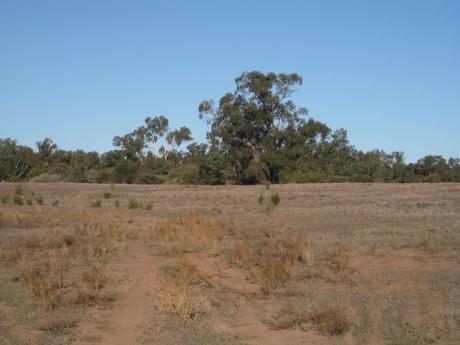
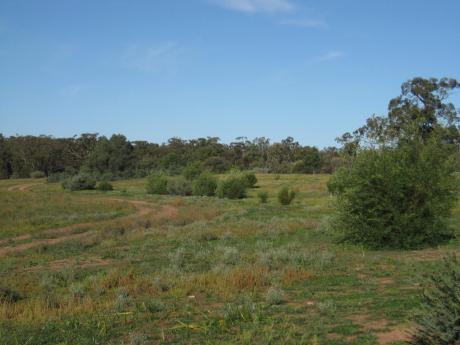 Recently I ventured to the Sandhills Rehabilitation block in MIA I - it being almost in my backyard. MFN did a fieldtrip there in May 2018, and we noted how the direct seeding done in 2015 was progressing, and we wandered around the early 2000’s planting of tube stock by NSW Forests. Back then we could see some success with the direct seeding and generated a limited bird list from the older plantings on top of the hill.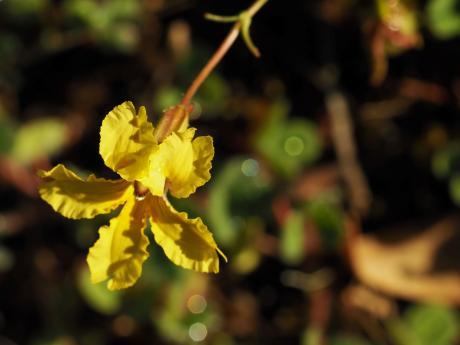
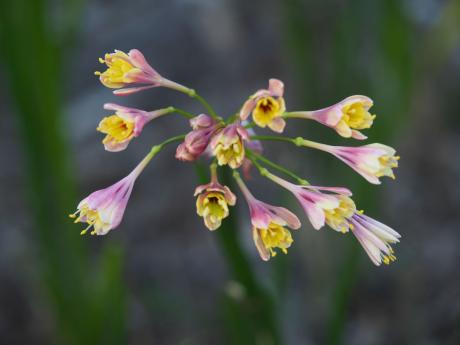 These sunny autumn days are great to explore the natural areas around Narrandera. The wonderful thing is that you don’t have far to go just to get to the Flora and Fauna reserve (the Common) and the Narrandera Regional Reserve with the Murrumbidgee River floating past.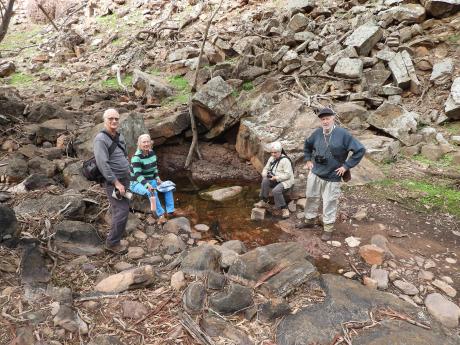
 We all, for the first time this year clad in jumpers and jackets, assembled at 8.30am at Yenda for our Cocoparra Ranges outing on Saturday, March 13.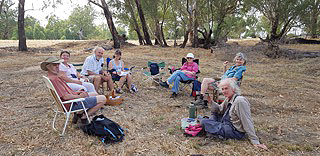
 Long time MFN member from Griffith, Melanie Baulch has put forward the proposition for forming an affiliated group in Wagga Wagga. After moving there a few years ago she hasn’t found a group that fits with the way she likes to see nature so wants to rectify that and become part of MFN. Field naturalist groups are quite unique. It is proposed to have a sub-committee with a vice president and other positions to organise events around Wagga. Current members will be encouraged to participate in these activities. This will be a similar setup to when Griffith held meetings and organised outings.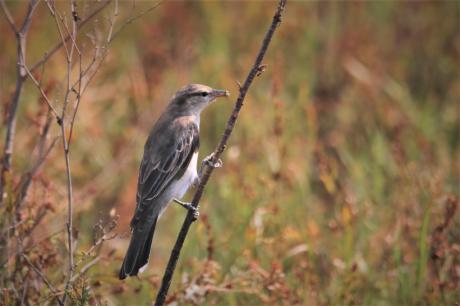
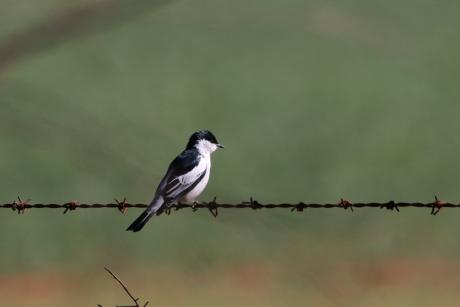 It is always of interest to notice how birds move within Eastern Australia at various times of the year. In this article I am not referring to the Migratory Wading Birds that we know about but local Australian species.
 On November the 16th a group of us gathered at the Lions park in Darlington Point in preparation for an excursion into the Murrumbidgee Valley National Park at the Cuba entrance. It was a very cool morning for the middle of November so there was some exchange of jackets before we headed the couple of kilometres back toward Leeton to the Cuba Forest.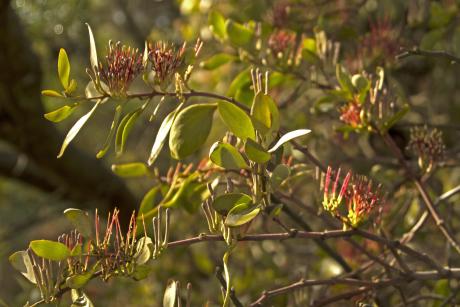
 Ten brave souls met at the Tourist Information Centre in Griffith trusting in my ability to get us to McCann Road.
Pages